Marketplace & warehouse operations

One portal for seven marketplaces, purchase orders, and a photoshoot floor

Myntra, Flipkart, Ajio, Snapmint, Shopify, Delhivery and the warehouse system each have their own portal, their own file format and their own way of being late. This covers all of them in one place, with permissions deciding who sees which.

~90 screens

covering marketplace, purchase-order and studio operations

7 platforms

marketplace and logistics integrations

Group-based

access control, per route

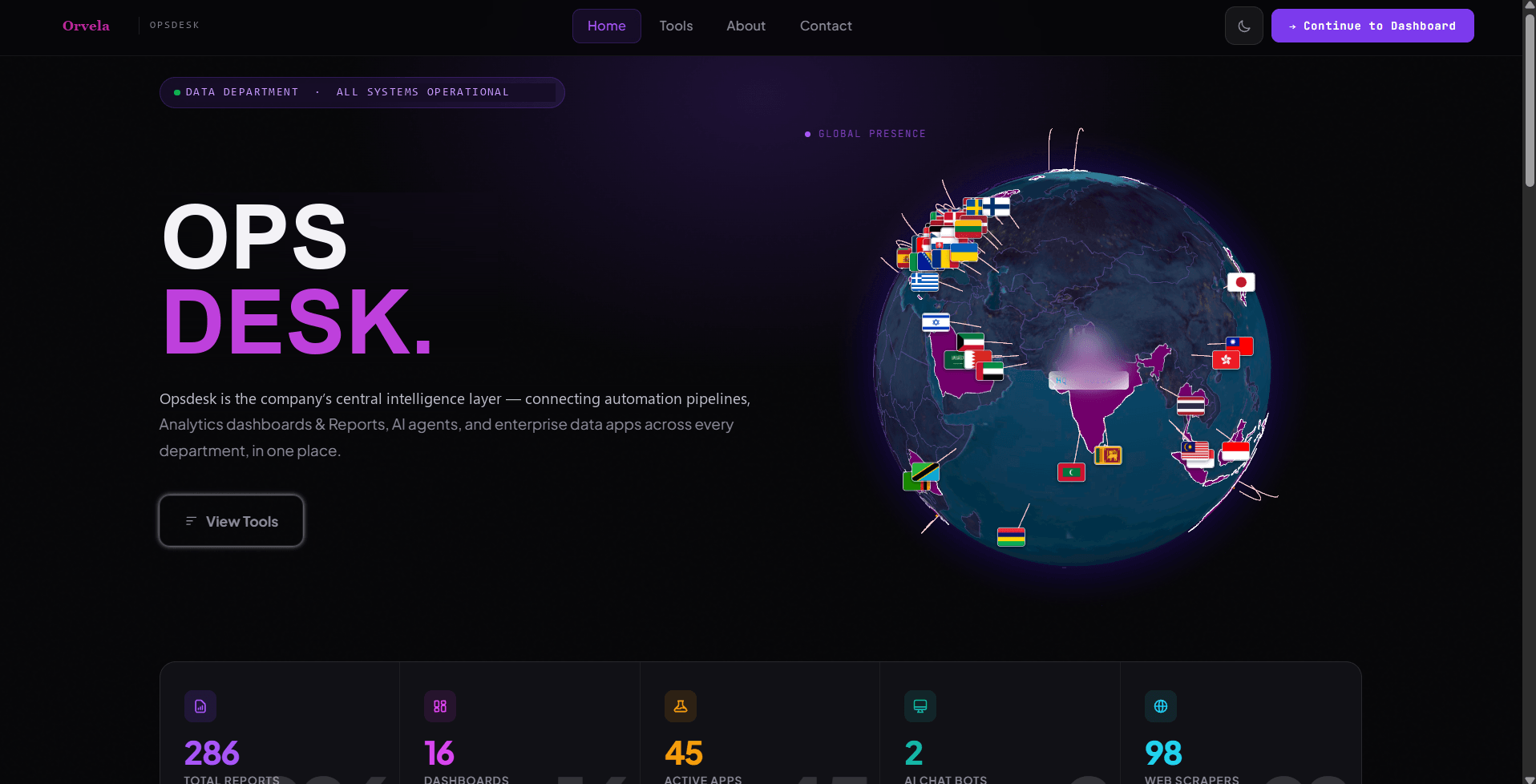
Operations portal landing page with a system status badge, a globe of the regions served and counts of reports, dashboards, apps, chat bots and scrapers.

Swipe to see the full screen

One entry point for seven external platforms and the work that falls between them.

The situation

An operations team selling across seven external platforms was running the business out of spreadsheets and an email thread per problem. Each marketplace has its own portal, its own claim process and its own settlement file format.

The work that fell between systems — raising a claim, chasing a purchase order, tracking a product through a photoshoot — had no system at all.

What I built

An operations portal that covers the work between the systems, with role-based access so each team sees only its own screens.

  • Marketplace operations across seven platforms: claim raising, protection-fund searches, incident management, settlement exports.
  • A purchase-order and material ticketing workflow, with a scheduler that emails turnaround-breach warnings before anyone has to chase.
  • A studio photoshoot production tracker running request → handover → photoshoot → return → confirmation → closure, because in apparel the studio is an operations bottleneck nobody builds software for.
  • A scheduled job that pulls settlement reports out of a mailbox automatically, so nobody downloads anything by hand.
  • An analytics dashboard reading pre-computed snapshots rather than hitting the warehouse on every page view.
  • Utility tooling that removes real daily friction: bulk image renaming, duplicate listing detection, and a PDF invoice reader.
ORVELA

Opsdesk

Operations control room

212 open

Purchase orders

Reminders go out before the breach, not after

POVendorRaisedTAT dueValueStatus
PO-26-4417Cedarwood Textiles02 Jun 2616 Jun 26₹8.4 LBreached · 4d
PO-26-4422Palladio Interiors05 Jun 2619 Jun 26₹3.1 LDue in 2d
PO-26-4431Lumen Print Works09 Jun 2623 Jun 26₹1.2 LOn track
PO-26-4440Northline Logistics12 Jun 2626 Jun 26₹6.7 LOn track
PO-26-4451Vertex Staffing16 Jun 2630 Jun 26₹2.9 LOn track

Swipe to see the full screen

Purchase orders with turnaround tracking, and a reminder that goes out before the breach.
ORVELA

Opsdesk

Operations control room

Studio floor

Request

24

Handover

18

Photoshoot

31

Return

12

Confirmation

9

Closed

146

In the studio now

Products between leaving the warehouse and being sellable

StyleCategoryStageOwnerDays in stage
OV-KS-4812KURTA SETRequestAnanya R.1
OV-K-4849KURTIHandoverVikram S.2
OV-D-4886DRESSESPhotoshootMeera T.3
OV-CS-4923CO-ORD SETReturnRohit K.4
OV-S-4960SAREEConfirmationPriya N.5

Swipe to see the full screen

The studio floor as a tracked pipeline — the operations bottleneck nobody builds software for.

Decisions worth explaining

The choice, why it was made, and what it means for you. Skip the middle part if you like — the point still lands.

01

Pre-computed snapshots rather than live warehouse queries

The choice

The dashboard reads columnar snapshot files refreshed on a schedule from the warehouse.

Why

An operations dashboard opened by forty people every morning should not run forty warehouse queries, and the underlying numbers change once a day anyway.

What it means for you

The page is instant, and the warehouse is not competing with the reporting team.

02

Permissions on routes, not on menus

The choice

Each group carries an explicit allowlist of routes it may reach, enforced server-side.

Why

Hiding a menu item is a design decision, not an access control. The URL is still there.

What it means for you

A warehouse user cannot reach a finance screen by typing its address, which matters the first time someone tries.

03

Fetch, do not wait to be sent

The choice

Settlement reports are pulled out of the mailbox on a schedule rather than filed by a person.

Why

Any step that depends on someone remembering to download an attachment will be the step that breaks during a busy week.

What it means for you

The data is there on Monday morning whether or not anyone did anything on Friday.

For the technical readerUnder the hood
  • Flask application with a Plotly-based analytics layer, SQL Server via an ODBC driver, and directory single sign-on issuing application tokens.
  • Group-based role control with per-group route allowlists.
  • Scheduled jobs for purchase-order reminders and for mailbox scraping of marketplace settlement reports.
  • Columnar snapshot caching refreshed from a cloud SQL Server warehouse.

What it changed

  • Around ninety screens, each of which replaced a spreadsheet, an email thread, or somebody walking to another desk.
  • The studio stopped being invisible to operations.

Where this applies to you

Any brand selling across several marketplaces, where each platform has its own portal and the work between them has no home. The photoshoot tracking applies to any business with an internal production step between buying a product and being able to sell it.

Screenshots show the real interface with sample data. Platform names are third-party marketplaces, not the client.

Tell me what’s slow, manual, or unreliable.

Twenty minutes on a call is usually enough for me to tell you whether software is the answer and roughly what it would cost. If it isn’t, I’ll say so.

Available for freelance builds alongside senior engineering work. One or two projects at a time.